
Sound healing with tuning forks has become increasingly popular in the UK among wellness professionals, therapists, yoga teachers, and people seeking non invasive approaches to relaxation and nervous system regulation. At the same time, it raises many practical and scientific questions.
People want to know how tuning forks are used for sound healing, whether they actually work, what frequencies like 528 Hz or 432 Hz do to the body, whether there is real science behind healing frequencies, who should not use tuning forks, and whether tuning forks are used in medicine or neurology. This article answers all of those questions clearly, responsibly, and in detail.
Sound healing with tuning forks refers to the use of calibrated metal instruments that produce a consistent vibration when struck. Unlike music, which is complex and variable, tuning forks generate a single measurable frequency. In sound healing practice, these vibrations are introduced near or sometimes gently on the body to support relaxation, awareness, and regulation. Practitioners do not diagnose or treat illness. Instead, tuning forks are used as a sensory input that can influence how the nervous system perceives safety, rhythm, and calm.
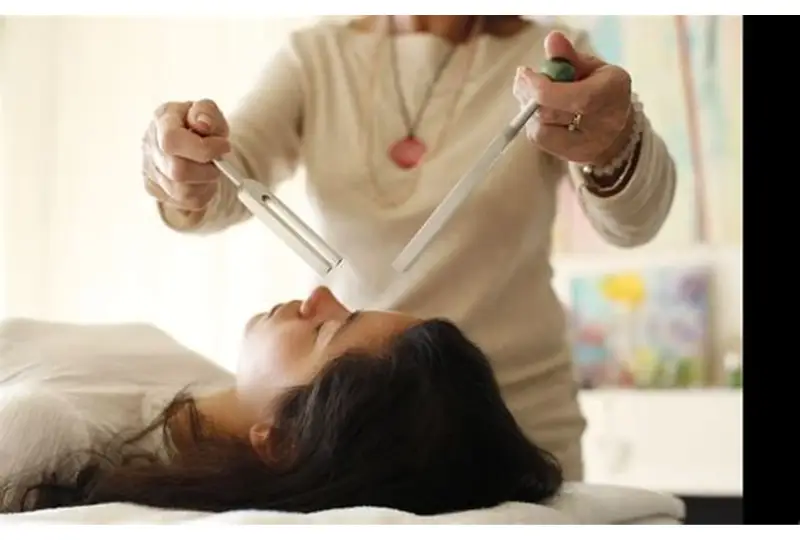
To understand how tuning forks are used for sound healing, it helps to understand what happens when vibration enters the body. Humans perceive vibration not only through hearing but also through mechanoreceptors in the skin, joints, and deeper tissues. When a tuning fork is activated and placed near the body, the vibration can be sensed physically as well as auditorily. Many practitioners describe tuning forks as a precise tool, sometimes referred to metaphorically as a sonic needle, because they allow focused application rather than filling an entire room with sound.
Using tuning forks for sound healing typically involves activating the fork by gently striking it against a rubber activator or a firm but forgiving surface. Hitting the fork too hard can distort the vibration and shorten its sustain, while hitting it too softly may not fully activate the frequency. Once activated, the fork is either held in the air within the client’s sensory field or lightly placed on specific areas of the body, depending on training and safety considerations. Proper activation technique is one of the most important foundational skills, because consistent vibration is essential for predictable sensory input.
Many people ask whether tuning fork therapy can be done on yourself. Self use is possible for simple relaxation and awareness practices, such as holding a gently activated fork near the body or ears to support calm breathing. However, self practice should remain conservative and simple. Advanced techniques, prolonged sessions, or work near sensitive areas should be learned through professional training. This is especially important because it is harder to observe your own nervous system responses objectively while applying sound.
A common question is whether tuning forks really work for healing and whether there is any science behind tuning forks or healing frequencies. The honest answer requires nuance. Tuning forks are absolutely recognised in medical and neurological contexts, but not as healing tools. In medicine, tuning forks are used diagnostically to assess hearing, nerve conduction, vibration perception, and in some cases to help identify bone fractures. Neurologists use tuning forks to test peripheral neuropathy and sensory nerve function. Sports medicine practitioners have historically used a 128 Hz tuning fork to help detect fractures based on vibration transmission. These uses demonstrate that tuning fork vibration clearly interacts with the human nervous system and musculoskeletal structures.
What science does not currently support are claims that specific frequencies directly heal organs, repair DNA, or cure disease. There is no credible evidence that frequencies such as 528 Hz or 432 Hz can produce direct biological healing effects in the way medication or surgery does. Responsible sound healing practitioners do not make these claims. Instead, sound healing is best understood as a supportive practice that may influence nervous system states, stress responses, and subjective experience.
The nervous system plays a central role in how the body responds to sound. Research in neuroscience and psychology shows that rhythm, vibration, and predictable sensory input can influence arousal and relaxation. Sound can support parasympathetic activation, which is associated with rest, digestion, and recovery. This does not mean sound heals conditions directly. It means sound can help create internal conditions that support regulation and wellbeing. This distinction is critical for ethical and professional practice.
People often ask about the placebo effect in relation to sound healing. Placebo does not mean imaginary or fake. It refers to the measurable ways expectation, context, and perception influence physiological responses. Many therapeutic practices, including those used in mainstream healthcare, acknowledge placebo response as part of how humans regulate stress and pain. Sound healing may engage similar mechanisms by offering predictable, calming sensory input that supports the nervous system’s sense of safety.
Questions about specific frequencies are among the most searched topics in sound healing. One of the most discussed is 528 Hz. Many online sources refer to 528 Hz as a frequency of transformation or DNA repair. These claims are not supported by scientific evidence. In practice, some sound healing traditions associate 528 Hz with emotional uplift or clarity, but these associations are symbolic and experiential rather than biological facts. When practitioners use a 528 Hz tuning fork, they are not repairing DNA. They are offering a particular vibrational input that some clients subjectively experience as pleasant or centering.
Similarly, 432 Hz is often discussed in contrast to the modern musical standard of 440 Hz. Claims that 432 Hz is more natural or more aligned with the body are largely philosophical rather than scientific. There is no evidence that tuning music or tuning forks to 432 Hz produces inherent healing effects. Some people prefer the sound quality of 432 Hz and find it subjectively calming, which can be meaningful in a therapeutic context without being framed as a medical claim.
When people ask what tuning forks do to the body, the most accurate answer is that they provide vibration that the nervous system perceives. This perception can influence muscle tone, breathing patterns, emotional state, and attention. Some clients report feeling calmer, more grounded, or more aware of their bodies. These effects are related to sensory processing rather than direct physical healing.
Safety is an essential part of any discussion about sound healing with tuning forks. Although tuning forks are generally gentle, they are not appropriate for everyone in every situation. People with seizure disorders, acute psychosis, severe sound sensitivity, or certain neurological conditions should approach sound healing with caution or avoid it altogether unless working with a suitably trained professional. Direct application of tuning forks over fractures, inflamed tissue, or implanted medical devices should be avoided as a precaution. Sound healing should never replace medical or psychological care, and practitioners should never advise clients to stop prescribed treatment.
Another common safety question is what the side effects of tuning forks might be. Most responses are mild and temporary. Some people experience fatigue, emotional release, lightheadedness, or heightened awareness following a session. These effects are typically related to nervous system activation and relaxation. A trained practitioner knows how to pace sessions, ground clients afterward, and stop if a response becomes overwhelming.
People also ask what the two things are that should never be done when using tuning forks. From a professional perspective, the first is forcing sound when a client shows signs of discomfort or distress. Sound healing should support regulation, not override it. The second is working outside your scope of practice by diagnosing conditions or making healing promises. Ethical sound healing stays firmly within supportive wellbeing, not medical intervention.
There is growing interest in whether tuning forks can stimulate the vagus nerve. While sound and vibration can influence parasympathetic activity, it is inaccurate to claim that tuning forks directly stimulate the vagus nerve in a targeted or medical way. What can be said is that calming sensory input may support vagal tone indirectly by reducing stress and supporting relaxation.
Finally, people often ask what neurologists use tuning forks for. In neurology, tuning forks are diagnostic tools. They are used to assess vibration sense, peripheral nerve function, and hearing pathways. This medical use demonstrates that tuning forks interact reliably with the nervous system, but it does not validate therapeutic healing claims. Professional sound healing training makes this distinction clear and teaches practitioners how to speak about their work responsibly.
In summary, sound healing with tuning forks is best understood as a supportive, sensory based practice that works with the nervous system rather than against it. It is not medicine, it is not a cure, and it does not rely on belief in mystical frequencies. When used responsibly, tuning forks can offer a precise, gentle way to support relaxation, awareness, and nervous system regulation. For anyone interested in using tuning forks professionally, proper training, ethical boundaries, and safety awareness are essential.
Sound healing Course - Mastering tuning forks - LEVEL I

Duration: 2 Days
Format: In Person (Faringdon, Oxfordshire) or Online
Who is this for:
Open to beginners and practitioners looking to integrate sound healing into their personal or professional practice.
About the Course:
A hands-on training to explore sound, vibration, and frequency, and learn how to use tuning forks for self-healing and client sessions.
What to expect:
Learn core theory, practical techniques (weighted & unweighted forks), chakra balancing, and how to conduct safe and effective sessions.
What you’ll gain:
Confidence in using tuning forks, deeper understanding of energy work, and tools to support healing for yourself and others.
Includes:
Training manual (digital & printed), certification (Level I), and ongoing support opportunities.
Important details:
Lunch provided for in-person sessions. Payment required prior to training. Limited spaces for hands-on experience.
SOUND HEALING WITH TUNING FORKS - LEVEL II

Duration: 2 Days
Format: In Person | Lunch Provided
Who is this for:
For practitioners who have completed Level I and want to deepen, refine, and expand their sound healing practice.
About the Course:
An advanced training to strengthen your skills in sound healing, including voice work, tuning forks, and group facilitation.
What to expect:
Refine techniques, explore chanting and sound meditation, learn advanced applications, and develop confidence in both in-person and remote sessions.
What you’ll gain:
Ability to lead sound baths, apply advanced tuning fork protocols, work with the biofield, and facilitate group healing experiences.
Includes:
Course manual, recorded materials access, supervised practice, and ongoing support opportunities.
Important details:
Full payment required before training. Instruments provided during in-person sessions.
Add comment
Comments